How Often Should You Train?

Gabriela D'Soares
Feb 24, 2026

Discover the ideal weekly training frequency you need for muscle and fat loss.
How Often Should You Train?
If you’ve ever wondered whether you should train 3, 4, 5 — or even 6 days per week — you’re not alone.
Training frequency is one of the most misunderstood variables in fitness. Some people believe more is always better. Others think three days is enough for everyone. And then there are those who train every single day, hoping effort alone will guarantee results.
The truth?
How often you should train depends on your goal, your experience level, your recovery capacity, and your lifestyle.
In this guide, we’ll break down the science and the strategy behind training frequency — so you can finally stop guessing and start progressing.
What Is Training Frequency?
Training frequency refers to how many times per week you train a muscle group or your entire body.
It’s not just about how many days you go to the gym — it’s about how often each muscle gets stimulated.
For example:
Full-body routine 3x per week → each muscle trained 3 times
Push Pull Legs 6x per week → each muscle trained 2 times
Bro split 5x per week → each muscle trained 1 time
And that difference matters.
The Science Behind Training Frequency
Research on hypertrophy consistently shows one key principle:
Muscle growth is primarily driven by total weekly volume — but frequency helps you distribute that volume effectively.
Studies indicate that training a muscle at least twice per week tends to produce better hypertrophy results than once per week — especially for natural lifters.
Why?
Because muscle protein synthesis (MPS) increases after training — but only for about 24–48 hours in trained individuals.
If you train chest only on Monday and wait another week, you're leaving potential growth on the table.
More frequent stimulation = more growth opportunities.
How Often Should Beginners Train?
If you’re new to the gym, your body responds to almost anything.
You don’t need high frequency or advanced splits. In fact, simplicity works best.
Recommended frequency for beginners:
3–4 training days per week
Full-body workouts or Upper/Lower split
Each muscle trained 2–3 times weekly
Why this works:
Faster skill development (you practice lifts more often)
Better recovery management
Lower risk of burnout
For beginners, consistency matters more than complexity.
How Often Should Intermediate Lifters Train?
Once you’ve been training consistently for 1–2 years, your body adapts.
Now progression requires smarter programming.
Recommended frequency:
4–5 training days per week
Upper/Lower split or Push Pull Legs
Each muscle trained 2 times per week
This allows:
Higher weekly volume
Better intensity distribution
Improved recovery between sessions
At this level, recovery becomes just as important as effort.
How Often Should Advanced Lifters Train?
Advanced lifters require more volume to stimulate growth — but they also accumulate more fatigue.
Recommended frequency:
5–6 training days per week
Structured split (Push Pull Legs, Arnold split, specialization phases)
Each muscle trained 2–3 times weekly
However, frequency should support recovery — not compromise it.
More training is only effective if:
Sleep is optimized
Nutrition supports recovery
Stress is managed
Otherwise, performance declines quickly.
Training Frequency for Muscle Gain
If your goal is hypertrophy, here’s the simplified rule:
Train each muscle 2 times per week
Accumulate 10–20 sets per muscle weekly
Spread volume across sessions
Example:
Instead of:
16 chest sets on Monday
Do:
8 sets Monday
8 sets Thursday
This improves:
Performance quality
Recovery
Strength output
Long-term growth
Training Frequency for Fat Loss
Fat loss depends primarily on calorie balance — not training frequency.
However, training helps preserve muscle mass and maintain metabolic rate.
For fat loss:
3–5 resistance sessions per week
2–4 cardio sessions (optional)
Focus on maintaining strength
Overtraining during a calorie deficit is a common mistake.
More sessions do not equal more fat loss — diet does.
Can You Train Every Day?
Technically, yes.
But you shouldn’t train every muscle intensely every day.
Daily training works when:
Volume is managed carefully
Muscle groups rotate
Intensity fluctuates
Elite athletes may train daily — but their recovery protocols are elite too.
For most people, 4–5 quality sessions outperform 7 mediocre ones.
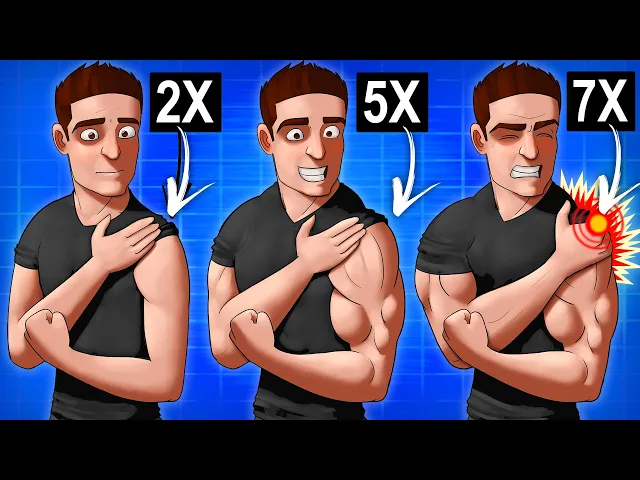
Signs You’re Training Too Much
More isn’t always better.
Watch for:
Constant soreness
Strength regression
Poor sleep
Elevated resting heart rate
Lack of motivation
Joint pain
If performance drops for weeks, it’s not a motivation issue — it’s a recovery issue.
Progress happens during recovery, not during the workout.
Signs You’re Not Training Enough
On the other hand:
Strength stagnates for months
Workouts feel too easy
Minimal muscle pump
No progressive overload
If you’re training once per week per muscle, that may be your bottleneck.
Frequency often fixes stagnation.
The Recovery Equation
Training frequency only works when recovery supports it.
Your recovery capacity depends on:
Sleep (7–9 hours)
Protein intake (0.7–1g per lb of bodyweight)
Total calories
Stress levels
Training intensity
If these are optimized, frequency can increase.
If not, more training will backfire.
The Ideal Weekly Training Setup
Here are three evidence-based setups:
Option 1: 3 Days (Beginner)
Full Body
Monday – Wednesday – Friday
Option 2: 4 Days (Balanced)
Upper – Lower – Rest – Upper – Lower
Option 3: 5–6 Days (Advanced)
Push – Pull – Legs – Rest – Push – Pull – Rest
Choose based on:
Experience
Schedule
Recovery capacity
Not based on what influencers do.
Here's a video that can help you in your own jorney:
The Biggest Mistake People Make
They copy advanced lifters.
High-frequency programs look impressive — but without the recovery foundation, they destroy progress.
The smartest approach?
Start conservative. Increase frequency only if:
Performance improves
Recovery stays strong
Strength increases consistently
So… How Often Should You Train?
Here’s the simple answer:
Beginner → 3–4 days/week
Intermediate → 4–5 days/week
Advanced → 5–6 days/week
Each muscle → 2x per week
That’s the sweet spot for most natural lifters.
Remember:
Progress is not about how often you train.
It’s about how well you recover.
Train hard. Recover harder.
And adjust based on performance — not ego.